
Типовые выражения (меняйте время, подлежащее, подставляйте свои данные, а также заучивайте):
Пример работы с выражениями: She always chops onions before cooking dinner (оригинал)
- She’s chopping the onions (Present Continuous)
- I have chopped the onions (Present Perfect)
- She never chops garlic (отрицание в Present Simple)
- You should chop celery first (рекомендация)
Справочник английской грамматики
| She always chops onions before cooking dinner. | My brother ordered oysters at the seafood restaurant—so fancy! |
| My dad loves to roast chicken with garlic and potatoes. | They served salmon with a lemon-dill sauce at the wedding. |
| They usually eat out on Fridays—sushi or Italian. | He never eats pork, but he loves grilled lamb. |
| He accidentally swallowed a cherry pit last summer! | We pour sunflower oil into the pan before frying eggs. |
| We boil eggs for breakfast and pour them into cold water. | My friend is allergic to nuts, so she avoids cookies with almonds. |
| My grandma still bakes bread from scratch every Sunday. | The chef carefully chopped garlic and added it to the soup. |
| The kids hate chewing celery, but they love carrot sticks. | They usually have cottage cheese with honey and berries for dessert. |
| People in Thailand fry rice with pineapple and shrimp—it’s delicious! | She baked a watermelon salad? No—wait, that’s not a thing! |
| I always add a pinch of salt when cooking pasta. | My mum always serves cabbage soup when someone’s sick. |
| She mixed mushrooms, zucchini, and tomatoes for a quick stir-fry. | He swallowed his food too fast and got a stomachache. |
Task: Complete the Sentences
Instructions: заполни пропуски верным глаголом из списка
Vocabulary List: chop, roast, eat out, swallow, boil, bake, chew, fry, add, mix, order, served, pork, pour, allergic, chopped, cottage cheese, baked, serves, swallowed
- My dad loves to _____ chicken with garlic and potatoes for Sunday dinner.
- I always ________a pinch of salt to the water when I’m cooking pasta.
- She always __________ onions before she starts cooking.
- The kids hate to __________ celery because it’s so stringy.
- We __________ eggs for ten minutes to make them hard.
- My grandma loves to __________ bread from scratch every week.
- He accidentally __________ a cherry pit and got scared.
- My friend is __________ to nuts, so she can’t eat anything with almonds.
- Let’s __________ some oil into the pan before we add the eggs.
- For a quick dinner, you can ____ mushrooms and zucchini together in a wok.
Типовые вопросы (меняйте время, подлежащее, вопросительные слова и тип вопроса, если это возможно):
| Does your family usually eat out on weekends? | What were you cooking when the power went out? |
| What do people in your country add to borscht—sour cream or garlic? | Was she mixing the sauce while he was chopping carrots? |
| How often does she cook with eggplant or zucchini? | Were your friends eating out when you called them last night? |
| Do you chew your food slowly or quickly? | What were the kids doing while you were boiling potatoes? |
| What do kids usually eat for lunch at school? | Was your brother pouring vinegar into the salad when you walked in? |
| Are you cooking anything special this week? | Are you going to cook a roast turkey for the holiday? |
| Is your flatmate baking cookies right now? I smell something sweet! | Is she going to bake a strawberry-raspberry pie this weekend? |
| What are they serving at the café today? | What are they going to serve at the dinner party—beef or salmon? |
| Are your parents trying to eat more vegetables like lettuce and cucumber? | Are your parents going to try that new vegetarian recipe with lentils and celery? |
| Is he still ordering takeout every night? | Is he going to order oysters again? He loved them last time! |
| Did you fry the chicken or roast it yesterday? | Will you add sugar to your tea, or do you prefer it plain? |
| What did they order at the seafood restaurant—shrimp or mussels? | Do you think they’ll serve watermelon at the summer picnic? |
| Did your grandma bake bread when you were a child? | Will your friend cook with cranberries this winter? |
| How did she chop the onions—by hand or in a food processor? | Who will chop the peppers if I’m busy frying the sausages? |
| Did anyone swallow a grape seed by accident? | Will people still eat beef in 30 years, or will everyone switch to plant-based food? |
Task: Finish the dialogue
Инструкция: дополни диалоги, выбрав логичный и грамматически правильный ответ на вопрос.
Диалог 1
A: Is your flatmate baking cookies right now? I smell something sweet!
B: …
a) Yes, she bakes them every day.
b) No, she doesn’t like cookies.
c) Yes, she is! She’s trying a new recipe.
d) Yes, she baked them yesterday.
Диалог 2
A: What were you cooking when the power went out?
B: …
a) I am going to cook pasta.
b) I will cook soup.
c) I was frying chicken. It was very annoying!
d) I cooked dinner an hour ago.
Диалог 3
A: Are your parents going to try that new vegetarian recipe?
B: …
a) Yes, they try it every week.
b) Yes, they were trying it when I called.
c) Yes, they are going to try it tonight.
d) Yes, they tried it yesterday.
Task: «Ситуативная практика»
Инструкция: Ответь на следующие вопросы полными предложениями о себе или своей жизни. Постарайся использовать ту же грамматическую структуру, что и в вопросе.
- Do you chew your food slowly or quickly?
Пример ответа: «I usually chew my food quite quickly, but I’m trying to be slower.» - What were you doing when your friend called you last night?
Пример ответа: «I was watching a movie when my friend called.» - Are you going to cook anything special this weekend?
Пример ответа: … - Did your family eat out last weekend?
Пример ответа: … - Will you cook dinner tonight?
Пример ответа: …
Task: «Спроси сам»
Инструкция: Изучи ответы ниже и составь к ним правильные вопросы. Используй подсказки в скобках.
- Ответ: No, I’m not. I’m ordering pizza.
Вопрос (задать вопрос к подлежащему «you»): …? - Ответ: Yes, she did. She baked it every Sunday.
Вопрос (задать вопрос к подлежащему «your grandma»): …? - Ответ: They are going to serve salmon.
Вопрос (задать вопрос к дополнению «salmon»): …? - Ответ: I was boiling potatoes.
Вопрос (задать вопрос к дополнению «potatoes»): …? - Ответ: No, he won’t. He’s allergic to them.
Вопрос (задать общий вопрос): …?
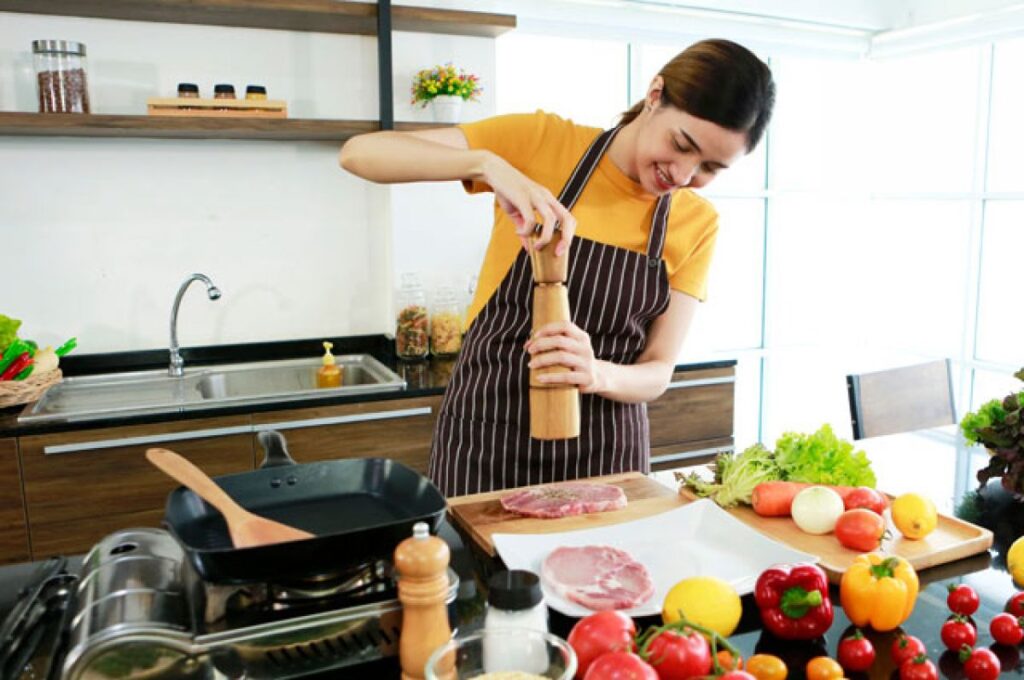
Опишите что происходит на фото (назовите продукты, элементы интерьера и что делает девушка):
Вопросы для обсуждения:
— What’s your favourite home-cooked dish, and who usually cooks it in your family?
— Do you prefer eating out or cooking at home? Why?
— Is there a vegetable or ingredient (like cabbage, eggplant, or garlic) that you used to hate but now enjoy?
— How important are traditional recipes in your culture? Do you still follow them, or do you experiment?
— If you could only eat one fruit for the rest of your life—apple, banana, watermelon, or pineapple—which would you choose and why?
Video
Reading
More Than Just Food: The Language of Cooking
Cooking is more than chopping onions or boiling potatoes—it’s a language of care, memory, and connection. Every verb tells a story: we chop with focus, fry with excitement, roast with patience, and bake with hope (especially when cookies are involved!).
In many homes, the kitchen is where traditions live. A grandmother’s borscht with sour cream, a father’s grilled salmon with lemon, or a child’s first attempt at scrambled eggs—these moments are stitched together by simple actions: pour, mix, add, serve.
But food also reflects change. Today, people order meals online, eat out more often, or try plant-based versions of beef and sausages. Yet, the joy of cooking together remains timeless. There’s something deeply human about chopping vegetables side by side, swallowing laughter (and maybe a bit of garlic) while sharing stories.
And let’s not forget the drama of the kitchen! Ever burned rice while texting? Swallowed a cherry pit by accident? Or cried while chopping onions—only to laugh about it later?
From crisp lettuce in a summer salad to steaming cabbage soup in winter, from honey-drizzled cottage cheese to spicy shrimp stir-fry, food speaks in flavours, textures, and verbs. It’s not just about what we eat—but how we prepare, share, and remember it.
So next time you pour oil into a pan or bake a pie, remember: you’re not just making dinner. You’re speaking a universal language—one recipe at a time.